How to adjust macros for training days: the science
Most apps give you the same targets every day. We look inside the algorithmic rules that scale your fuel to match your actual training load.

Most apps give you the same targets every day. We look inside the algorithmic rules that scale your fuel to match your actual training load.
When people apply to the KEXBI beta, the form gives them an open field to ask anything about fuelling. Most take it. What comes back is the most honest statement of what people who train seriously want from a fuelling app.
What follows is grouped by theme, biggest theme first. Every answer is something the app already does. The References at the bottom list the studies behind it.
The biggest theme was macros. How much protein. How to balance it against carbohydrate and fat. Whether it needs spreading through the day. How the split changes when the training changes.
The short answer is that 1 g per lb (about 2.2 g per kg) is an upper bound, not a target. Research on trained adults settles on 1.6 to 2.2 g per kg per day for keeping muscle and building it. Above that, returns diminish quickly. KEXBI sets protein per kg of lean mass (your weight minus your fat) and caps it at 3.1 g per kg of lean mass. That cap is KEXBI's default rule, not a limit of biology.
When your training changes, your protein target usually stays put. What changes is the carbohydrate underneath it. Endurance work burns through muscle glycogen, which is stored carbohydrate. Add the pool to a lifting week and your carbohydrate has to climb to replace what the swim uses up. Your protein might drop very slightly, or stay flat. KEXBI works all of this out for you. Each day, it sets protein from your lean mass, adjusts carbohydrate to match the day's training, and keeps fat at 0.66 g per kg or higher.
They were right to push back. On a big training day, the extra energy should almost never come from protein. It should come from carbohydrate, because the work itself is a carbohydrate event. KEXBI decides the day's macros by looking at what the day contains, not by handing you the same numbers every day. Hard days carry more energy, and most of the extra is carbohydrate. Protein moves only slightly, and never above the 3.1 g per kg of lean mass cap.
It helps. Total daily protein matters most, and research suggests a meal builds muscle best once it delivers about 2.5 g of leucine, an amino acid found in protein. Below that, the muscle-building response is smaller [1, 2]. KEXBI aims for 10 g of leucine a day, spread as roughly 2.5 g in each of four meals. From 65 onwards, the per-meal target rises to 3.0 g, because older muscle needs a bigger push to respond [3, 4].
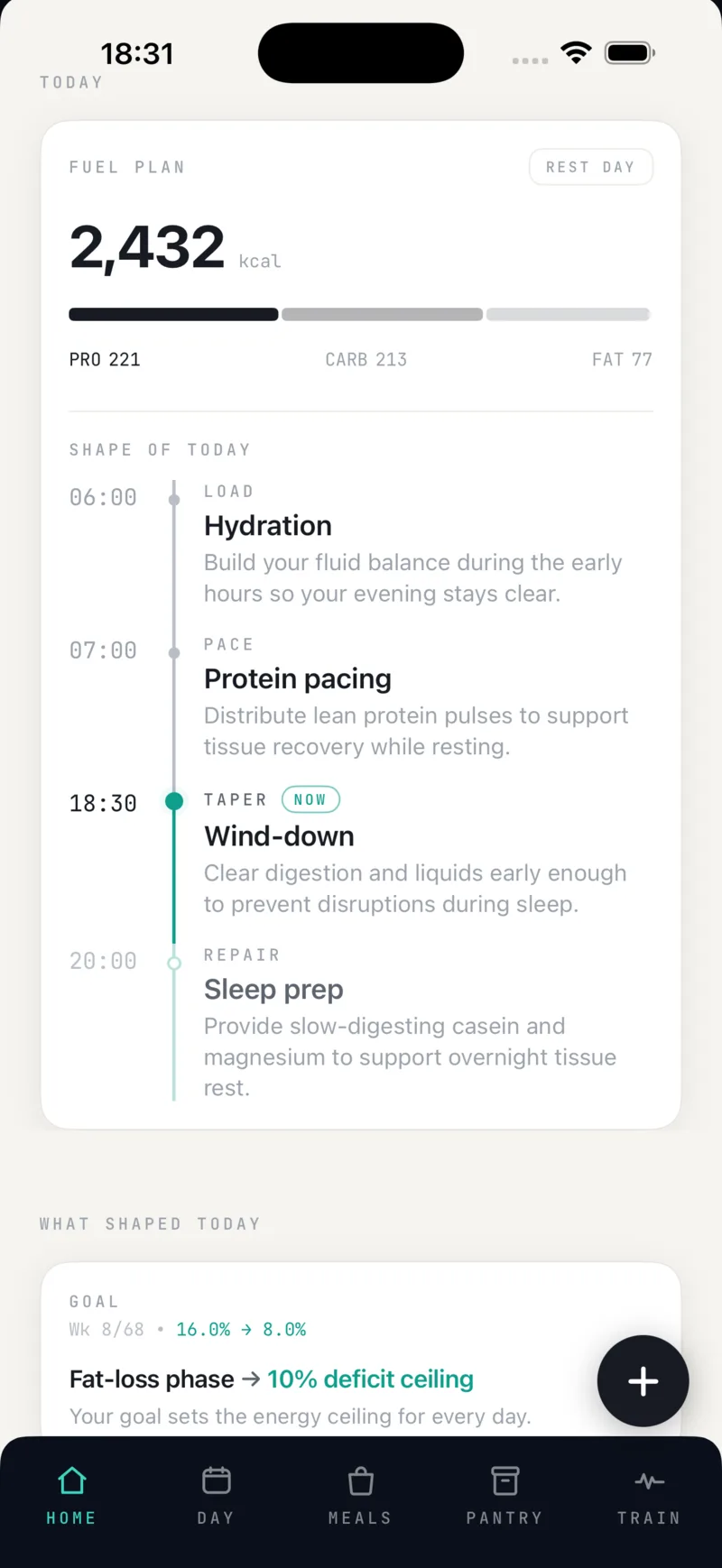
When you eat below maintenance, protein needs to go up (to help keep muscle) and fat needs a floor (for hormonal health). KEXBI works to hold four numbers that no deficit should drop below.
Protein sits at 2.4 g per kg of lean mass during fat loss. It goes up slightly from forty, and again from fifty-five. The cap of 3.1 g per kg of lean mass still applies. Carbohydrate takes the remaining calories, and cannot drop below its floor.
KEXBI works to enforce all four of those. Most widely used calorie apps enforce one or none.
The rest of the cluster reduces to the same answer. How to get macros. How to track them. How to see them per meal. KEXBI works out your daily targets from your body composition and the day's training, then spreads them across the meals where the body can actually use them. You do not enter macros. You do not adjust them. The full working is on the engine page, with cited research behind every number.
The second theme was timing. What to eat and when. The best carbohydrate source for training. Blood glucose before, during and after training.
The three windows behave differently, and KEXBI treats them separately.
Before you train (roughly 90 to 30 minutes out). The job is to top up the liver's carbohydrate store, without eating so late that food is still in your stomach when you start. KEXBI uses slower-release carbohydrate (oats, sweet potato) at 60 to 120 minutes before, and lighter fast carbohydrate at 30 minutes before for shorter workouts.
During training. For anything longer than about an hour at moderate to high intensity, KEXBI adds carbohydrate while you work. How much depends on what you are doing and your body weight, broadly 30 to 60 g an hour for typical endurance work. For very long training, more, with a mix of sugar types so the gut can absorb it faster.
After training. The first 30 to 60 minutes is when the body refills carbohydrate stores and starts repairing muscle. KEXBI places a fast-carbohydrate plus leaner-protein snack there, then a proper meal an hour or so later for the longer rebuild.
There is no single answer, because a carbohydrate's usefulness depends on the moment. Fast-releasing carbohydrate (white rice, dextrose, gels) is ideal after training, when the body wants speed. Slower-releasing carbohydrate (oats, sweet potato, whole grains) is ideal before, when the body wants a steady drip. Same nutrient, different moment, different job. KEXBI knows how quickly each food releases sugar, and picks the one that fits the slot.
A common thread: how do I fuel a hard training day differently from a rest day? How do I combine running with lifting in the same week?
Struggling on the hard training days is often a sign you are under-fuelling. Most calorie apps hand you the same daily number seven days a week, so a hard day becomes a hidden deficit. The body can respond with hunger, low mood, and workouts that never quite land.
KEXBI works the other way. Each training day, the app works out roughly how many calories the workout burned, using a standard scale for effort adjusted for your body composition. It adds that back to the day's target. Rest days sit at the base target. Training days sit higher, funded by the training itself.
We do not add all of it back, because the body claws some back on its own. Research suggests the body spends a little less energy elsewhere, even without you noticing. On average, about 28% of the calories you burn in exercise are quietly reabsorbed that way. The figure comes from a large study of 1,754 adults [8]. Apps that give you 100% of your logged workout back overfeed the day. The most-used app in the category is one of those.
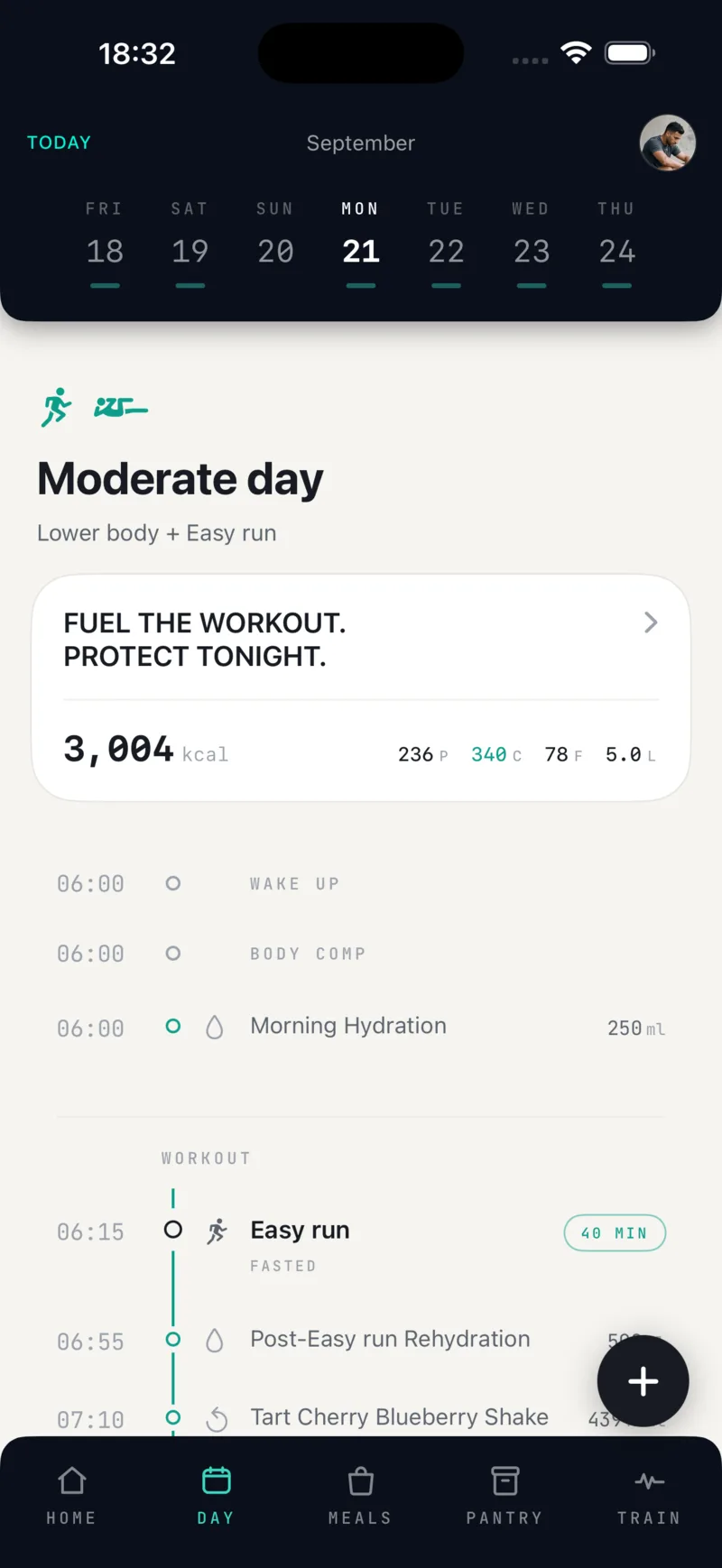
Feeling full and steady is easier when you move more and eat more, rather than move less and eat less. Both can produce the same net calorie balance, but research suggests the higher-turnover version may help your metabolic rate and hunger control [9]. That is why KEXBI would rather scale a hard day up than pull a rest day further down. Protein is split across four meals, each large enough to support muscle building, rather than crammed into dinner. Hunger tends to settle when the day is fuelled well. It does not need to be fought.
Beta reader Luke, Cohort 001: his previous coach put him on a flat number every day, around 3,000 kcal. On a rest day, that is roughly maintenance. On a heavy lifting day with a run, it is a real deficit dressed up as maintenance, and it may be where the low-mood, hard-to-lift days came from.
The other big cluster of questions was about the food side rather than the numbers side. What to actually cook. The quickest meal that still tastes good. Good food at reasonable cost. Dietary preferences.
These are one question in four forms. KEXBI builds every meal from the food already in your pantry. You mark items as staple, occasional, or not in the pantry. The plan only picks from what is there. You choose between two cooking modes each week: prep in one go on Sunday, or cook fresh through the week. Different mode, different meals, different shopping. The shopping list is built to the plan, split into what to buy and what you already keep.
Dietary preferences sit inside the same system. A taste profile has three inputs. An adventure dial, for how far the plan should stretch beyond what you normally cook. The kitchens that feel like home: Italian, Thai, Indian and thirteen others. And a never-serve list, for ingredients you refuse to eat. The plan steers toward your profile, and keeps anything on the never-serve list out of what it brings in.
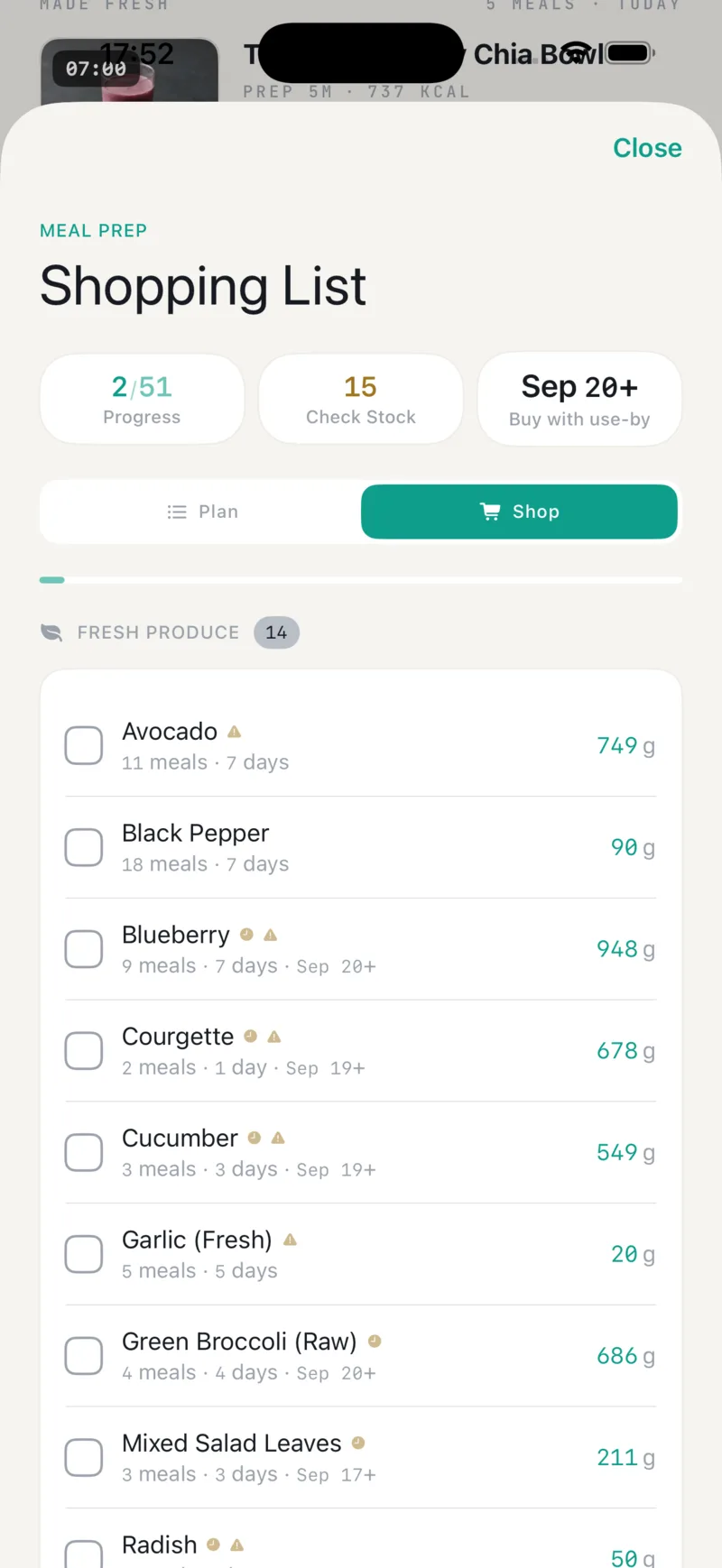
Beta reader Luke again, eleven weeks in: "My weekly shop is about £30 less than it was." Same food he likes, less impulse buying. The plan decides what to buy before you get to the aisle. You buy what the week needs, not what you might.
He is right that any AI can cook one up. That is the problem. A chatbot writes a plan by predicting the next word, not by weighing food or checking safety. KEXBI is built the other way round.
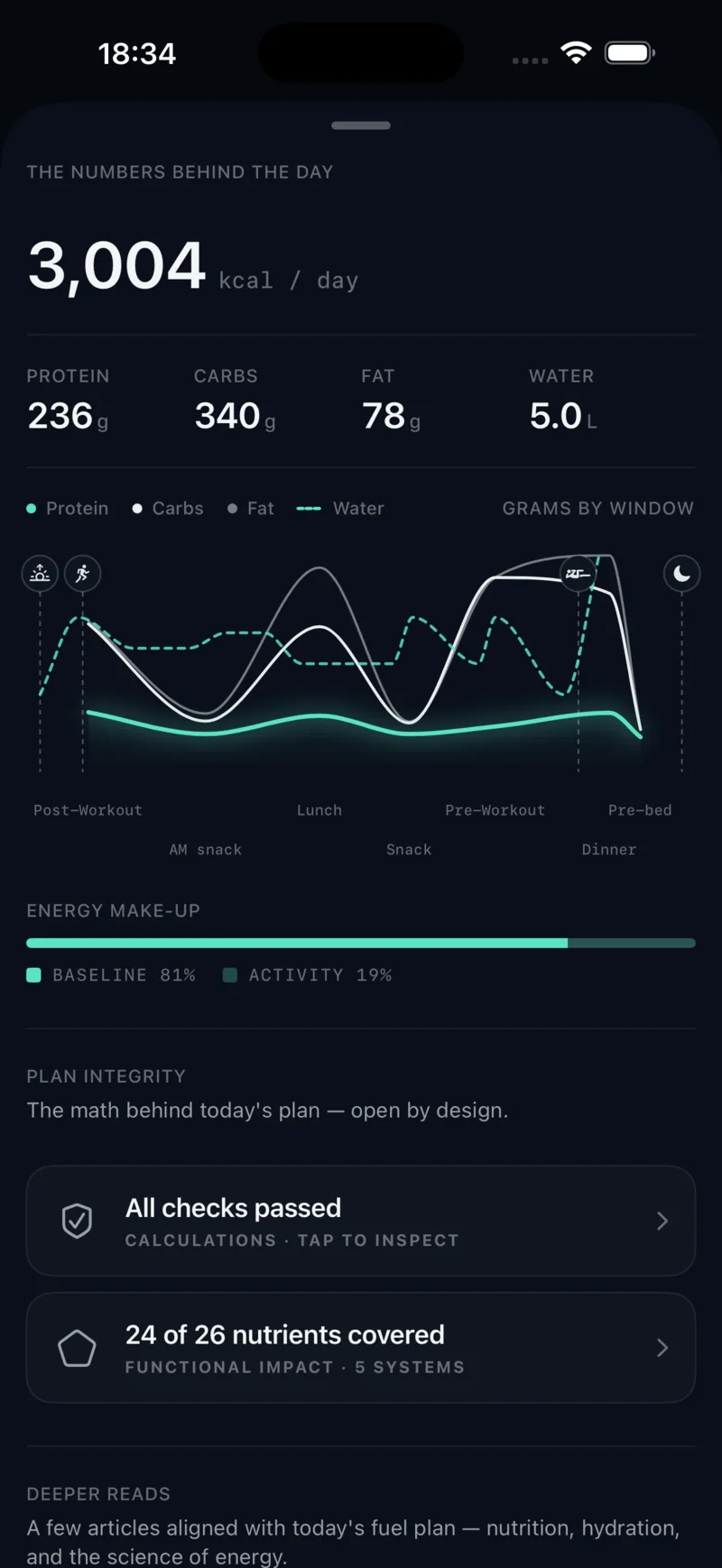
The engine is a fixed pipeline of 26 specialists, grouped into six areas: recovery, timing, fuel, safety, adaptation, and the food actually in your pantry. Behind those sit 112 core calculations and 370 rules, drawn from 95 peer-reviewed sources. Every number in the app comes from that chain, and you can tap any number to open the working. Only after the numbers are decided does a language stage write the meals themselves, and it has to fit the numbers already worked out.
As for the nutritionist claim: KEXBI does not replace one for medical questions. Illness, disease-state fuelling, prescribed drugs, rehabilitation from injury or surgery. All out of scope. What it takes on is the daily work that takes up most of a nutritionist's time with a healthy client. Setting today's targets against training and body composition. Splitting them across meals. Choosing the food. Writing the shopping list. Catching a bad night's sleep and adjusting. Doing that again tomorrow.
Before a plan reaches you, nine integrity checks run against it. They include the floor that stops the app asking you to eat too little to build, the fat floor (0.66 g per kg and at least 20% of energy [5, 6]), the carbohydrate floor (100 g a day [7]), the calorie floor (1,500 for men, 1,200 for women), the weight-loss rate cap (1% of body weight a week), and the protein ceiling (3.1 g per kg of lean mass). They are designed so no part of the app can override them. If any check fails, the plan is sent back and rebuilt.
Then the test that matters: how does it hold up against the tools your clients already use? We put the same test person through NHS / NICE, MacroFactor, calculator.net, the NIH Body Weight Planner, RippedBody, Legion, MyFitnessPal, Precision Nutrition, Renaissance Periodization, and Carbon. Six safety checks were run on every result. KEXBI was the only tool that passed all six on all three test profiles.
We ran the same test on a frontier chatbot. We gave it the full brief for a real training day, took its plan, then weighed the food behind it. Not one meal landed the macro split it prescribed. Misses ran 20 to 75 percent. It set fat targets the food underneath could not reach. Its "either / or" meal options were 60 percent apart on protein. The day did not add up to its own total, and the plan crossed two safety floors along the way. The full audit is here.
The point is not that AI is useless. It is that a chatbot on its own cannot build a plan that hits its own numbers, because it cannot weigh the food underneath the words. The engine works the other way round: it runs the numbers first, then writes the meals second, from a real food database and against the safety checks.
Three of the questions do not have a good answer in KEXBI today. Rather than dress that up, we name them.
Someone sidelined for about twelve months across two knee operations asked how to fuel the recovery. Rehabilitation from surgery is a medical question. The safety layer inside KEXBI is designed to help keep fuelling safe during normal training. It is not built to plan meals for someone recovering from an operation. That depends on the surgery, the phase, and the surgical team. The right place for that plan is your surgeon, your physio, and a clinical dietitian.
Someone on Mounjaro, working on a body recomposition, asked how to hit their protein target when the drug suppresses appetite. The medication itself is out of scope. It is a prescribed drug with a specific clinical picture that KEXBI is not built to plan around. What we can offer, and what the engine already does, is the protein-distribution side: hitting the daily target in smaller, more frequent doses that fit the reduced appetite. If the daily target is landing but the drug is the issue, that is a conversation with the prescriber, not the app.
Someone asked how KEXBI adjusts for menopause. Today, it does not, and we would rather say so. This is a product gap first. There is research on menopause-specific protein, carbohydrate and timing adjustments, but it is still developing. What is not there yet is a feature we have built and tested with the right cohort. When we add it, we will test it with women in that life stage first, and only ship it once the results hold up. That is the bar every new feature has to clear here, and menopause is the wrong one to cut corners on.
Hunger and cravings came up more than once. Hunger is answered above, by fuelling the day properly and spreading protein across meals. Cravings work differently. They are driven by the brain's reward circuits, and the engine does not try to solve them. People often tell us cravings settle as fuelling stabilises, but that is a report, not something we designed for. If cravings are your main problem, it may be a behavioural issue, worth taking to a coach, your GP or a registered dietitian.
Four large clusters, one sceptic, three honest gaps. Read together, they add up to something simple. People who train seriously do not want more numbers. They want fewer numbers, and for those numbers to be right for the day in front of them. They want the food already sorted. They want to stop guessing.
That is what KEXBI is built for. If one of the questions above sounded like yours, the app is ready when you are.